
A Childhood Memory from the Poor Countryside of Tra Dong
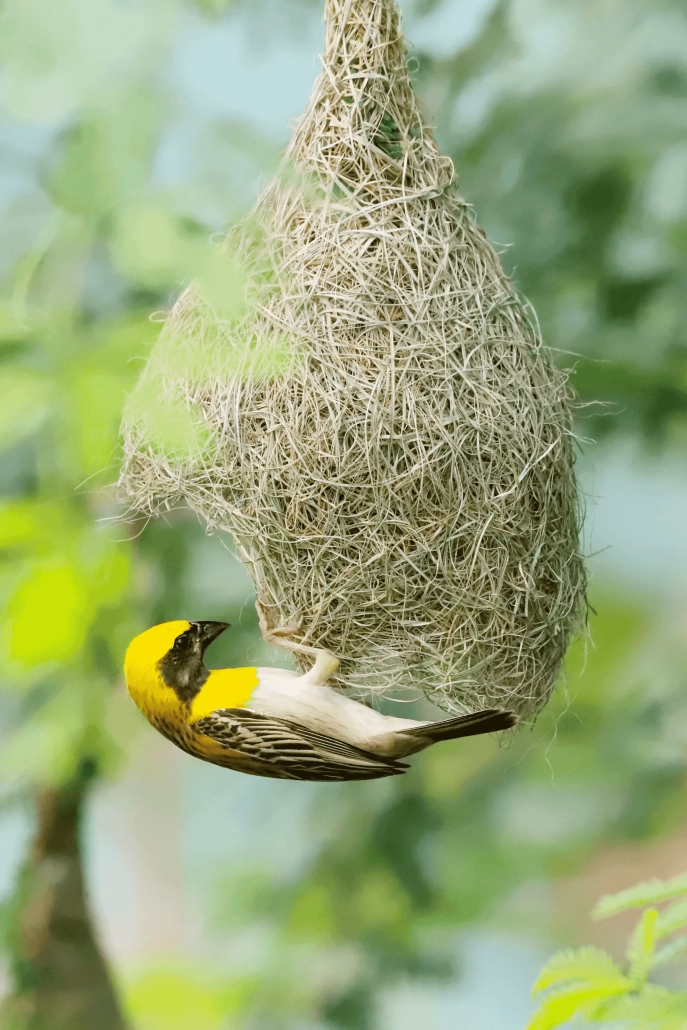
THE WEAVER BIRD
Some memories seem to disappear with time.
They sink quietly into a distant corner of the mind, and for years we believe they are gone.
Then one late night, for no particular reason, they return.
Clear.
Vivid.
Almost untouched by time.
A poor countryside village.
A summer afternoon.
A herd of buffalo.
The sound of an explosion.
And a tiny weaver bird that became part of my childhood.
I cannot remember exactly when it began, but every year, around the fourth month of the Vietnamese lunar calendar, flocks of weaver birds would return to my hometown.
They arrived with the beginning of the hot season, when the sun burned the skin, the grass in the fields turned dry, and the rice paddies were heavy with grain.
It was the time when farmers were preparing to harvest the results of months of hard work.
The birds came in groups, sometimes in great flocks.
And then they began building their nests.
Their nests were unlike anything else I had ever seen.
Carefully woven from grass and plant fibres, each one was made with remarkable skill and structure. Hanging high from the tips of bamboo branches, they looked like small hammocks swaying in the wind.
I never knew whether the male or the female did most of the building. All I knew was that the birds worked in pairs, each competing to create another extraordinary nest at the very top of the bamboo.
Our house stood on a small rise.
Right in front of it were five or six thick clusters of bamboo.
Every season, more than twenty nests would hang there, moving gently in the breeze.
The children in our village had developed our own little rule.
When the long entrance of the nest began to grow, the chicks inside were almost ready to leave the nest.
That was when we prepared our equipment.
A machete.
A long bamboo pole.
And a little lime used for chewing betel.
The lime was important because hornets and wasps often built their nests near the weaver birds.
If we were stung, we would immediately rub lime onto the spot.
That was what we believed would help.
One day, I began climbing a bamboo tree.
Higher.
And higher.
Until I looked down and my friend standing on the ground had become tiny.
Finally, I reached the nest.
I hooked it toward me with the bamboo pole.
My heart was pounding with excitement.
I quickly reached inside.
What terrible luck.
There was only one chick.
The other three eggs had gone bad.
Perhaps because it was the only surviving chick, its parents had fed it particularly well.
It was unusually fat and healthy.
I carefully tucked it against my back and slowly climbed down.
The moment I reached the ground, all the other children crowded around me.
“How many? How many? Are they ready to fly? Give me one!”
I held the little bird tightly.
“Only one! I climbed for it, so it’s mine!”
And that was that.
I took it home.
But I was nervous.
I was afraid my grandmother would find out that I had climbed such a tall bamboo tree.
Back then, if you fell from a tree, being hurt was not necessarily the end of your trouble.
Sometimes you would get punished again for being foolish enough to climb it in the first place.
The baby weaver bird arrived at its new home frightened and confused.
No mother.
No father.
And our cat kept watching it from the corner of the room with far too much interest.
I made a small bamboo cage for it and lined the bottom with a few pieces of straw.
That became its new home.
Raising a weaver bird was far more difficult than I had expected.
Unlike some other young birds, it would not open its mouth and cry when it was hungry.
It would simply lie there quietly.
So I fed it in the morning.
Again two or three times around midday.
And again in the evening.
I would hold it in my hands and feed it grain by grain.
The rice had to be chewed until it was soft.
There were no feeding syringes, special bird food, or little bottles like people have today.
I simply softened the food in my mouth before giving it to the chick.
And somehow, it ate.
Day after day.
Week after week.
Before I knew it, more than a month had passed.
Its feathers grew.
Then one day, it learned to fly.
I do not know whether weaver birds are naturally that intelligent, or whether being raised by a little buffalo boy who fed it chewed rice somehow made it different.
But that little bird became unbelievably clever.
Wherever I went, it followed me.
When it became tired of flying, it landed on my shoulder.
When I went to graze the buffalo, it followed.
When I swam in the river, it would sit on a nearby branch as if it were keeping watch over me.
Without my noticing exactly when it happened, that little bird had become my friend.
Then came the fifth day of the fifth lunar month.
It was a festival day, and almost everyone in the village had gone out to enjoy themselves.
But I still had to take the buffalo to the fields.
And of course, the weaver bird had to come with me.
At around eight in the morning, after breakfast, I opened the buffalo pen.
The bird was sitting on my shoulder.
I climbed onto the large male buffalo that usually led the herd, and the rest followed behind us.
A little more than two kilometres from home, I noticed three men digging in the ground.
At that time, scrap metal was valuable.
People sometimes came from the city with metal detectors, searching the countryside for old pieces of iron and unexploded wartime ordnance that they could sell as scrap.
Curious, I moved closer.
Closer.
And closer again.
Then I saw it.
A huge bomb.
It must have weighed more than two hundred kilograms.
It looked so intact that I can still remember seeing letters and numbers printed on its metal body.
The men were digging around it with a crowbar.
Suddenly, I remembered my grandmother’s warning.
“There are still many bombs left in this area. If you ever see one, stay away from it. Don’t be curious. You could lose your life for nothing.”
I stood there thinking.
Then I told myself:
Better to leave. If that thing explodes, it would be a terrible waste to die along with three buffalo and my little bird.
I pulled hard on the rope through the buffalo’s nose and urged it forward.
Maybe the animal sensed something too.
That day, it ran unusually fast.
The lead buffalo ran.
The herd followed.
I went with them.
And the weaver bird flew above us.
Buffalo, bird and boy.
We had travelled a little more than two kilometres when suddenly—
BOOM!
The explosion tore through the countryside.
The buffalo beneath me reared violently.
I fell hard onto the ground.
The rope through its nose snapped.
My whole body ached.
The bird disappeared in one direction.
The buffalo scattered in another.
And I was left lying on the ground, stunned by both the fall and the force of the blast.
After a while, I managed to sit up.
I turned around.
A huge cloud of smoke was rising behind me, as if an entire field were on fire.
I slowly made my way back to see what had happened.
By then, people from the village were already running toward the scene.
Of the three men, two had stayed behind and tried to cut the bomb apart.
The third had gone to the market.
When he heard the explosion, he came running back.
The moment he arrived, his legs gave way beneath him.
“My God! Where is my brother? Where is my friend?”
An older man from the village looked around and said bluntly:
“There’s one piece over there, another over here, and there’s another piece up in that jackfruit tree. We told them not to cut that bomb, but they kept doing it anyway.”
In those days, in poor rural areas like ours, deaths caused by unexploded ordnance left behind after the war were not unheard of.
No one needed to be told what to do.
The villagers quietly began collecting what remained.
Flesh.
Bone.
Anything they could find.
They gathered the remains together and held a funeral for the two men.
People in the village could only sigh and say the old expression:
“You live by the trade, and sometimes you die by it.”
One day passed.
Then two.
Then three.
Then four.
The buffalo eventually found their way home.
But my weaver bird did not.
There was no sign of it anywhere.
I would sit at the table eating, but my eyes kept turning toward the door.
I did not dare tell my grandmother.
I was sad.
And I was afraid she would scold me.
I began to think the bird had died.
Or perhaps it had been so frightened by the explosion that it had simply flown away forever.
More than eight days passed.
Then one morning, I woke up and prepared to take the buffalo out again.
As I crawled out from under the mosquito net, I suddenly froze.
There it was.
Sitting on the post beside my bed.
My weaver bird.
It had come home.
I was so happy I did not know what to do.
The moment it saw me, it flew down and landed on my shoulder as if those eight missing days had never happened.
But something was different.
It made no sound.
The first day.
Nothing.
The second day.
Still nothing.
A week passed.
Then a month.
The bird never made another sound.
After that terrible explosion…
my weaver bird had become mute.
Time went on.
I continued caring for it.
Among the children in the village, it became known simply as:
“the mute bird.”
One year passed.
Then two.
It still followed me everywhere.
It came with me when I grazed the buffalo.
It followed me when I went to collect firewood.
There was no need to keep it locked in a cage.
There was no need to tie it.
It simply stayed.
And somehow, without anyone deciding it, that little weaver bird became part of our family.
Then another summer arrived.
My grandmother told me that I had to travel with her to Dak Lak to visit my parents.
I knew I would be gone for a long time.
I could not take the bird with me.
I stood in front of its old bamboo cage and looked at it for a long while.
Then I opened the door.
I said:
“All right, my little friend. Go back to your flock now.”
And I released it.
It flew away.
My grandmother took my hand and began walking.
But I kept turning around to look back.
And I cried.
I cried like only a child can cry when something important is leaving and he does not yet understand that some goodbyes are forever.
Time passes quietly.
It waits for no one.
Even now, I sometimes wonder what happened to that little weaver bird after I left my hometown.
Perhaps it found another bird.
Perhaps it built one of those beautiful hanging nests at the top of a bamboo tree.
Perhaps it had chicks.
Maybe somewhere, somehow, there are still generations of its descendants flying above those same old rice fields.
Or perhaps…
it died many years ago beneath a bush, in a field, or beside some dusty village road.
I do not know.
And I probably never will.
But after all these years, in the memory of that little buffalo boy I once was, the bird is still there.
A tiny bird.
A bamboo cage.
A rice field.
A bomb exploding in the heat of a summer morning.
And a friendship that did not need words.
Some companions walk beside us for only a short part of our lives.
Some memories seem forgotten, but in truth they are only sleeping quietly, waiting for a late night to return.
That little weaver bird never sang again after the explosion.
But in my memory, it has never truly been silent.
Tra Dong — written late at night, while remembering the buffalo-herding days of my childhood.
Reviews
-
Hau Andy 02/10/2026
Good